

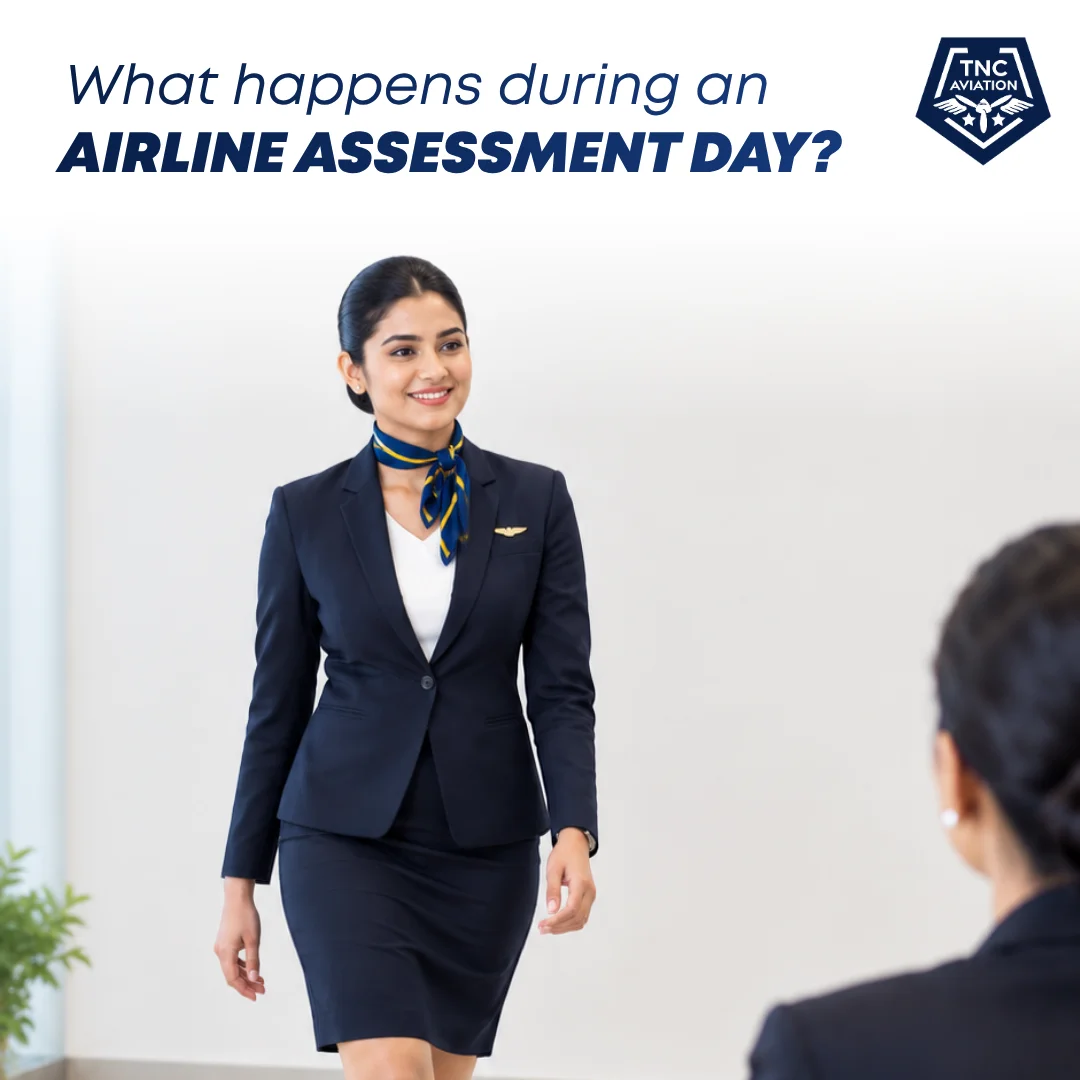
What Happens During an Airline Assessment Day?
An airline assessment day can be one of the most important stages in a cabin crew recruitment journey. For many freshers, the process can feel unfamiliar because candidates are assessed on much more than their answers during a personal interview.
Airlines may evaluate candidates throughout the day based on communication, grooming, confidence, teamwork, body language, customer-service mindset, and their ability to respond to different situations.
Understanding what to expect can help candidates prepare more effectively and approach the assessment with confidence.
What Is an Airline Assessment Day?
An airline assessment day is a structured recruitment process where candidates participate in one or more evaluation activities.
Depending on the airline and vacancy, the process may include:
- Document verification
- Initial screening
- Grooming assessment
- Group discussion or interaction
- Communication assessment
- Situational exercises
- Personal interview
- Final evaluation
The exact process can vary between airlines, so candidates should always follow the instructions provided in the official recruitment communication.
Step 1: Registration and Document Verification
The assessment may begin with registration and verification of candidate details.
Depending on the airline’s requirements, candidates may be asked to provide:
- Updated resume
- Educational certificates
- Identity documents
- Passport-size photographs
- Full-size photograph, where requested
- Passport or other required documents
Candidates should organise their documents before arriving at the venue.
Tip: Reaching early allows you to complete registration calmly rather than beginning the assessment under unnecessary pressure.
Step 2: Initial Screening
The first evaluation may involve a basic screening of candidates.
Recruiters may observe:
- Overall presentation
- Communication skills
- Confidence
- Grooming
- Eligibility
- Professional behaviour
This stage can be brief, but candidates should remember that their behaviour and communication may be observed throughout the assessment.
Step 3: Grooming and Presentation Assessment
For cabin crew positions, professional presentation can be an important part of the recruitment process.
Recruiters may assess:
- Neat appearance
- Posture
- Body language
- Professional attire
- Confidence
- Overall presentation
The objective is not simply to look attractive. Candidates should demonstrate professionalism, attention to detail, and an understanding of the expectations of a customer-facing aviation role.
Step 4: Group Discussion or Interaction
Some airlines may conduct group-based activities to understand how candidates interact with others.
Recruiters may assess whether you can:
- Express your ideas clearly
- Listen to others
- Respect different opinions
- Participate without dominating
- Work effectively as part of a team
There is no advantage in speaking continuously. Quality of communication and teamwork are more important than the number of times you speak.
Step 5: Communication Assessment
Communication is central to the cabin crew role.
Candidates may be assessed on:
- Clarity of speech
- Listening skills
- Vocabulary
- Confidence
- Pronunciation
- Ability to communicate naturally
Avoid trying to impress recruiters with complicated vocabulary. Simple, clear, and confident communication is generally more effective.
Step 6: Situational and Role-Based Activities
Some assessment days may include scenarios designed to understand how candidates respond to practical situations.
Examples could involve:
- Handling an unhappy passenger
- Managing a disagreement
- Responding to pressure
- Working with a team
- Solving an unexpected problem
Recruiters are generally interested in the approach you take rather than a memorised “perfect” answer.
Try to demonstrate:
- Empathy
- Calmness
- Presence of mind
- Professional communication
- Problem-solving ability
Step 7: Personal Interview
Candidates who progress through the earlier stages may be invited for a personal interview.
Questions may cover:
- Tell me about yourself
- Why do you want to become cabin crew?
- Why do you want to join this airline?
- What are your strengths?
- How would you handle an upset passenger?
- Tell us about a time you worked in a team.
Prepare thoroughly, but avoid memorising complete answers.
Use genuine examples from your education, work experience, internships, sports, volunteering, or other activities to demonstrate your skills.
Step 8: Letter of Intent (LOI)
Some airlines in India may issue a Letter of Intent (LOI) after candidates successfully clear certain recruitment stages.
An LOI may represent conditional selection, meaning additional requirements may still need to be completed before final onboarding.
Not every airline issues an LOI. Some may proceed directly towards final selection or follow a different recruitment structure.
Therefore, candidates should understand the specific process followed by the airline they are applying to.
Step 9: PHT (Pre-Hire Training)
Certain airlines in India may require candidates who receive an LOI to undergo PHT (Pre-Hire Training) before final onboarding.
PHT (Pre-Hire Training) is a structured training phase designed to prepare candidates for airline expectations and the professional requirements of the role.
Depending on the programme, PHT may include:
- Customer service and passenger handling
- Grooming and professional presentation
- Body language and confidence building
- Voice modulation and articulation
- Communication practice
- Scenario-based preparation
Why Is PHT Important?
PHT helps candidates strengthen the practical skills required to perform confidently in an airline environment.
Through rigorous PHT (Pre-Hire Training), candidates can improve their communication, confidence, professional presentation, and presence of mind, which can significantly support their chances of converting their LOI into final selection.
Step 10: Final Evaluation and Medical Requirements
After completing the applicable recruitment and training stages, candidates may undergo final evaluation and medical checks.
This may include:
- Required medical fitness reports
- Final documentation
- Internal evaluation
- Verification of applicable requirements
Medical requirements and tests can vary depending on the airline and applicable guidelines. Candidates should follow the specific requirements communicated by the airline.
Candidates who successfully meet the applicable requirements can then proceed towards final confirmation and onboarding.
What Recruiters Observe Throughout the Day
Remember that assessment does not necessarily stop when you finish a formal interview.
Recruiters may observe:
- How you interact with other candidates
- How you respond to instructions
- Your body language
- Your attitude towards staff
- Your communication style
- Your ability to remain composed
- Your professionalism
Treat every interaction as part of your overall professional impression.
Common Mistakes to Avoid
- Arriving late
- Incomplete documentation
- Poor grooming
- Giving rehearsed answers
- Dominating group discussions
- Interrupting other candidates
- Speaking too quickly
- Showing excessive nervousness
- Being unaware of the cabin crew role
- Assuming an LOI means guaranteed final employment
- Not taking PHT (Pre-Hire Training) seriously when applicable
How to Prepare for Assessment Day
Before attending, make sure you:
- Check the airline’s latest eligibility criteria.
- Prepare all required documents.
- Research the airline and understand the cabin crew role.
- Practise your introduction and communication.
- Prepare genuine examples demonstrating teamwork and problem-solving.
- Work on grooming and professional body language.
- Stay updated with relevant current affairs.
- Reach the venue early.
- Stay calm and professional throughout the day.
Conclusion
An airline assessment day is not simply an interview. It is an opportunity for recruiters to understand how candidates communicate, interact, respond to situations, and present themselves in a professional environment.
For freshers, preparation should focus on genuine skill development rather than memorising answers. Strong communication, confidence, grooming, teamwork, adaptability, and presence of mind can help candidates approach each stage more effectively.
Understanding the journey from assessment and interview to LOI, PHT (Pre-Hire Training), final evaluation, and onboarding can also help candidates prepare for what comes next.
Why Choose TNC Aviation?
TNC Aviation helps aspiring cabin crew candidates prepare for airline recruitment through:
- Structured PHT (Pre-Hire Training), where applicable
- Personality development and grooming sessions
- Communication and confidence-building
- Interview and scenario-based preparation
- Guidance from experienced aviation professionals
At TNC Aviation, candidates are guided to develop the skills, confidence, and professional presentation needed to approach the airline recruitment journey with greater clarity and preparedness.
